
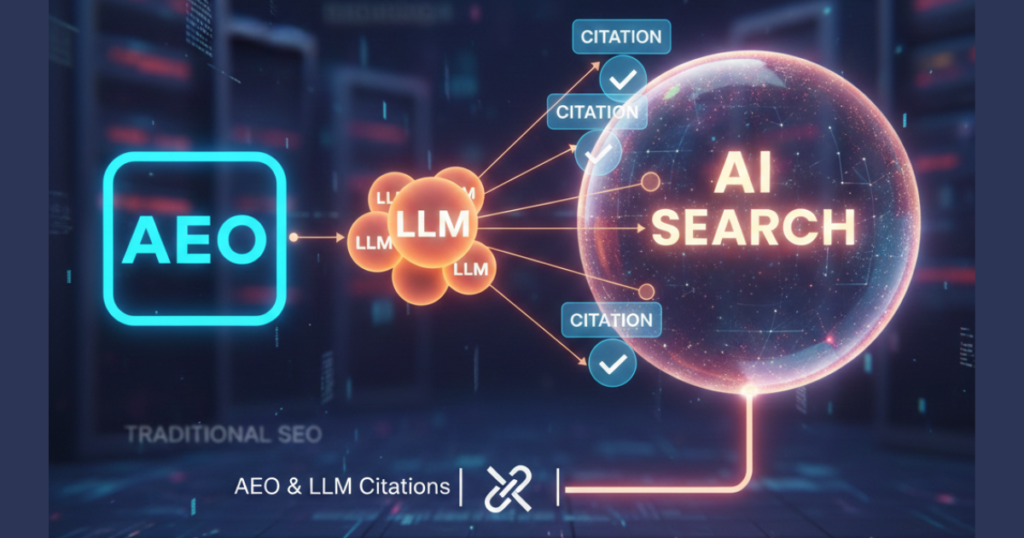
The internet is undergoing its most significant transformation since the search engine’s inception. For over two decades, digital marketing focused on a search-and-browse model aimed at securing Google clicks. However, the rapid rise of generative AI has fundamentally shifted this ecosystem, moving away from traditional browsing toward direct answers.
We’ve moved from the era of search to the era of the answer. Users now bypass traditional websites for AI platforms like ChatGPT, Claude, and Perplexity to get synthesized responses. This Zero-Click system replaces traditional rankings with a critical new metric: LLM Citations.
If a Large Language Model (LLM) doesn’t mention your brand, you’re essentially invisible. To future-proof your online presence, you must understand the mechanics of LLM citations and the technology behind them. Investing in Answer Engine Optimization (AEO) is the only way to ensure your brand remains a part of the AI’s synthesized conclusions.
The Paradigm Shift: From Blue Links to Synthesized Answers
Understanding LLM citations requires looking at changing user behaviors. In traditional SEO, the user acted as the researcher, scanning Google’s list of alternatives to read and synthesize information themselves. AI changes this by performing the research and synthesis on the user’s behalf.
The AI chatbots and answer engines relieve the user of the burden of research. They are like a concierge; they read the internet on behalf of the user and give him/her the finalized conclusion.
The Death of the “Ten Blue Links”
Gartner forecasts a 25% reduction in traditional search volume by 2026 as users move to conversational AI. This shift is already visible. When someone asks an AI for the best CRM for a real estate agency, they aren’t looking for links; they want a specific, synthesized recommendation.
And in case the AI responds, “Based on recent reviews and feature comparisons, it has integration functionality. You have won. The above mention is an LLM citation. It is heavier than an average search outcome, since it is accompanied by the implicit approval of the logic of the AI.
Decoding LLM Citations: How They Work
An LLM citation is not a backlink, but it usually has one. It is a factual reference to a brand, product, or fact in an answer generated by AI. To achieve such quotations, it is necessary to be aware of the two different approaches that AI may adopt in order to retrieve information.
1. Training Data (The Long-Term Memory)
Foundation models like GPT-4 and Gemini rely on long-term memory built from massive training datasets. If your brand maintains an authoritative presence on Wikipedia, major news outlets, or academic journals, it becomes part of the model’s intrinsic knowledge base. This allows the AI to reference your brand without needing to search the live web.
Securing citations from training data is a long-term branding strategy. It requires consistent PR and entity-building to ensure AI models recognize your company as a distinct entity rather than just another web page. This recognition allows the AI to cite you when answering open-ended questions from its internal memory.
2. Retrieval-Augmented Generation (RAG)
Retrieval-Augmented Generation (RAG) is the current frontier of AEO. This technology enables AI to navigate the internet in real-time to answer specific queries about news, pricing, or data. The LLM searches its trusted index, analyzes the top results, and synthesizes a final answer for the user.
Here, the struggle towards visibility is won or lost. The AI is searching after particular requirements to choose the source to quote:
- Formatted Understanding: Does the bot easily understand the data?
- Semantic Relevance: Does the content provide an answer to the particularity of the prompt?
- Authority Signal: Do other reliable nodes in the network support this source?
Provided that your content meets these requirements of RAG, then the AI will extract your information, summarize it, and attribute it to you as the source.
The Robots of the AI Choice
What are an AI’s reasons to mention one site and disregard the other one, yet the latter has a better domain authority? The solution is vector search and semantic proximity.
Traditional SEO relies heavily on keyword repetition and backlinks. In contrast, AI models use vector search, where words and concepts are converted into mathematical vectors. The AI then identifies content that is mathematically closest to the user’s intent, prioritizing semantic meaning over specific keywords.
The Significance of Information Gain
Google’s AI algorithms now prioritize information gain, punishing content that merely regurgitates existing information. If your article repeats generic advice found on dozens of other sites, LLMs have no incentive to cite you. They prefer unique insights over broad, compiled opinions.
Your work should have value in order to be eligible to receive an LLM citation. This could be:
- Primary statistical information or survey findings.
- An opposite opinion supported by experience.
- Proprietary systems/methodologies.
By providing information gain, you become one of the primary sources. The AI has no choice but to refer to you since there is no other place that can contain that particular piece of information.
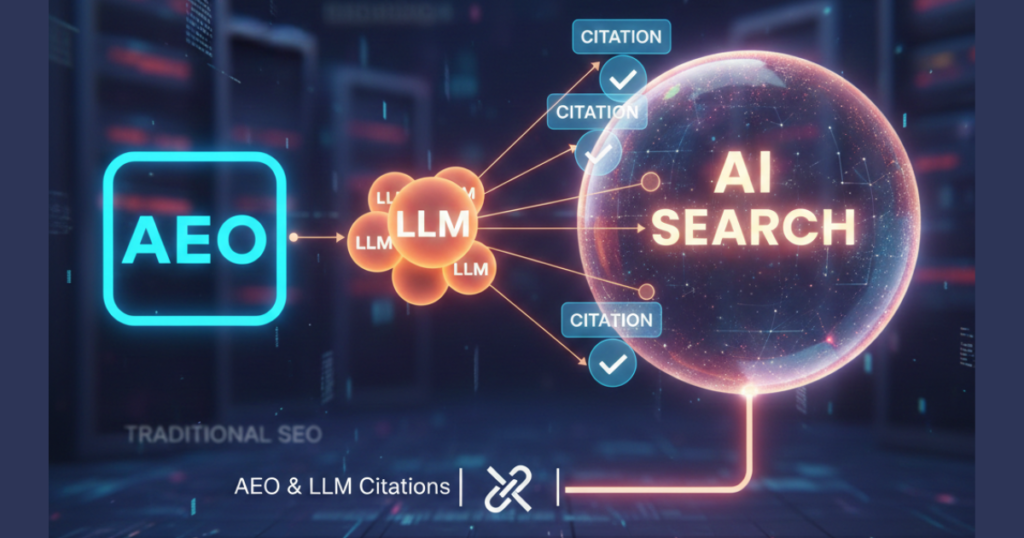
An Earning Citations Strategic Framework
Answer: Engine Optimization is not just “SEO and more.” It needs to be overhauled completely, technically and editorially. Being a leading provider of AEO services, we use a four-pillar strategy to generate a maximized citation rate.
Entity and Knowledge Graph Optimization
AI identifies brands as entities rather than just keywords. To ensure an LLM can cite you, we establish your brand within the Knowledge Graph by synchronizing information across platforms like Crunch base, LinkedIn, and Bloomberg. We use same As schema markup to create a verification web that proves your business is reputable and verified.
The Answer-First Content Architecture
There are limited attention spans (context windows) in AI models. We rewrite your content following the inverted pyramid style so as to make it extractable.
Advanced Schema and Structured Data
While basic SEO uses simple schema, AEO requires detailed structured data like FAQ Page, How To, and Dataset. This code acts as a machine language that identifies your content’s specific details. For example, we wrap pricing tables in code that defines the currency and billing cycle, removing ambiguity and significantly increasing your chances of being cited.
Co-Occurrence and Digital PR
AI determines trust through association, a concept known as co-occurrence. When authoritative publications discuss your brand alongside industry giants, the LLM’s association models learn to view your brand as a high-quality peer. We focus on these mentions to educate the AI, ensuring it associates your brand with industry standards.
The Risks of Inaction: The Ghost Effect
Ignoring AEO risks more than just traffic loss; it risks digital erasure. As AI Overviews push organic results below the fold, even a 6th-place ranking on Google could result in zero visibility. If your brand isn’t featured in the AI snapshot, you effectively don’t exist to the user.
Without clear, structured data, you risk AI hallucinations where models guess your business details. This can lead to false pricing, incorrect hours, or unavailable services being reported to users. Active AEO management ensures the data AI models consume is precise, controlled, and accurate.
The reason why you should hire professional AEO services
The transition to AEO requires a technical leap involving Natural Language Processing (NLP), Python-based data analysis, and advanced schema implementation. Most in-house teams are already stretched thin by Google’s core updates and lack the resources to reverse engineer algorithms from OpenAI, Anthropic, and Perplexity.
This is where we come in. We offer specialized AEO services that bridge the gap between your brand and the machines. It is not all conjecture on our side, but experiment. Using the responses of various models to your brand prompts, we tune your online presence to the preferred extent.
Our Service Deliverables:
- AI Sentiment Analysis: We scan what big LLMs are presently feeling about your brand. Are the mentions positive? Accurate? Nonexistent?
- Conversational Keyword Optimization: We leave short-tail keywords (e.g., “shoe store”) behind for long-tail, conversational queries (e.g., “Which shoe store in [City] has the best return policy on running shoes?”).
- Citation Tracking: We will keep track of the frequency and context of your brand being referenced by artificial intelligence search engines to give you a report on your percentages of the AI voice.
Conclusion
The shift from SEO to AEO is a radical redefinition of how we consume information. As AI agents become the internet’s primary gatekeepers, successful brands will be those that prioritize machine-readability and semantic authority over outdated keyword density strategies.
To become searchable is now insufficient; in this new age, you need to be citable. By matching your digital footprint and the needs of LLMs in the present day, you will be able to make sure that your brand will be the ultimate solution to the future.
Never leave your online presence to randomness or machine conjecture. Call us now and request to have your brand audited with regard to AI visibility, and we will make sure that your brand becomes the primary source of truth in AI search.