
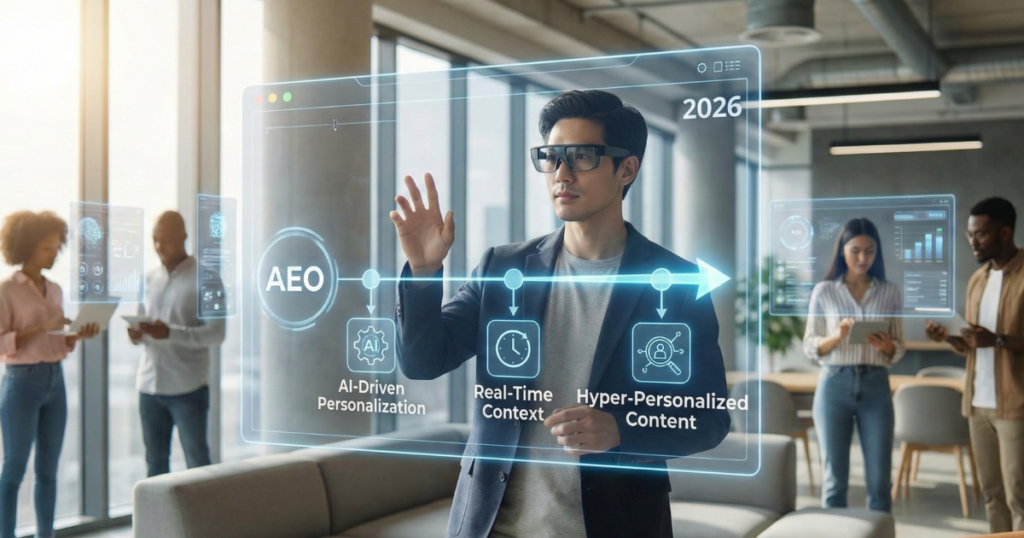
This shift has also changed how brands must structure content for AI answer engines, making Answer Engine Optimization (AEO) essential for personalization visibility.
Consumers today do not just like personalization; they insist on it. Whether browsing through a streaming platform, a web-based shopping platform, or using a banking application, users desire experiences to be designed in a way that seems intuitive and fits their individual needs and preferences.
AI-driven personalization fuels the shift from generic mass marketing to highly tailored experiences. By using AI and machine learning, your business can analyze vast datasets to predict intent and filter content. This allows you to deliver the right message at the exact moment it’s needed.
What is AI-Driven Personalization?
Tailoring every user interaction in real-time using artificial intelligence.
AI-driven personalization uses machine learning, NLP, and predictive analytics to scale individualized experiences. While traditional methods might only use a customer’s name, AI strategies go deeper by analyzing real-time behavior and historical data.
AI systems analyze several factors to adjust content and recommendations dynamically:
- Real-time behavior and historical data
- Contextual cues like location and weather
- Device type and user interface preferences
The ultimate goal is to create a ‘segment of one,’ treating every user as a unique individual rather than a broad demographic statistic.
How AEO Enhances AI-Driven Personalization in 2026
AEO structures content to enable AI to construct instant, hyper-personalized direct answers.
AEO ensures AI engines like ChatGPT and Google SGE understand and surface your personalized content. By structuring data around natural language and intent signals, AEO positions your brand as the direct answer to user queries.
In 2026, personalization without AEO limits visibility, while AEO-powered personalization ensures your tailored experiences appear exactly where AI-driven decisions are being made.
Core Technologies Behind the Magic
- Machine Learning (ML): It refers to algorithms that are able to learn by the patterns of data to enhance future predictions without requiring explicit programming.
- Natural Language Processing (NLP): Allows systems to read and write human language, and it drives chatbots and voice assistants that are conversational and context-sensitive.
- Predictive Analytics: This is data that relies on historical data to predict the future, which may be what a customer is highly likely to purchase next or when they are on the verge of churning.
- Generative AI: The latest one, where a brand can generate specific text, images, or video on-the-fly and provide it to individual users.
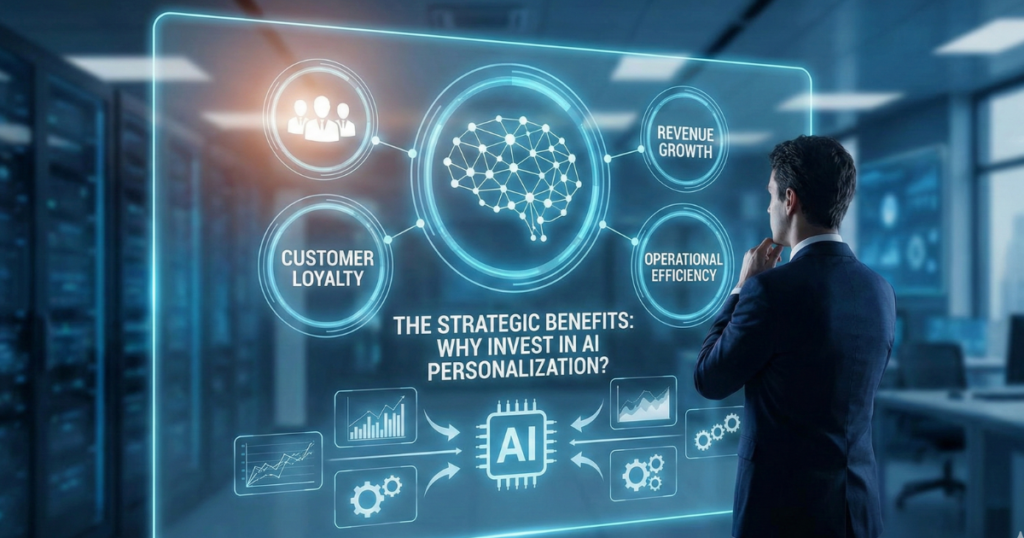
The Strategic Benefits: Why Invest in AI Personalization?
The AI transition is not about some cool technology, but it is about quantifiable business effects. It is the reason why organizations are doubling up on these tools.
1. Skyrocketing Customer Engagement
Users engage more with content tailored to their interests. Platforms like TikTok and Instagram use AI to adjust feeds in milliseconds based on viewing time, keeping users engaged. In e-commerce, relevant product displays reduce choice paralysis and encourage deeper browsing.
2. Higher Conversion Rates and Revenue
Relevance is a major revenue driver. According to McKinsey, companies that master personalization generate 40% more revenue from these efforts than their competitors. AI streamlines the purchase journey by removing friction and highlighting the most likely buying options immediately.
3. Enhanced Customer Loyalty and Retention
Retaining customers is more cost-effective than acquiring new ones. AI builds loyalty by making users feel acknowledged. When a brand predicts a need like a grocery app suggesting coffee beans just as you run out it creates a level of trust and convenience that’s hard for competitors to beat.
4. Operational Efficiency
Segmentation is slow and lacks accuracy when done manually. Through AI, the data analysis process is performed with heavy lifting, sending the marketing team to strategy and creative storytelling instead of spreadsheet management.
Real-World Success Stories
Several industry titans have set the benchmark for what successful AI personalization looks like.
- Netflix uses a recommendation engine that saves the company over $1 billion annually by reducing churn. Their AI goes beyond suggesting titles; it even customizes the artwork you see based on your specific viewing history.
- Spotify: The Wrapped campaign and Discover Weekly playlists are driven by advanced ML algorithms that evaluate listening behavior and previously listened-to music to generate music that seems hand-selected, making the data an intensely emotional experience that users look forward to year after year.
- Starbucks: Their mobile application is powered by their initiative, which suggests personalized orders depending on weather, time of the day, and purchase history, which contributes immensely to incremental sales.
- Sephora: Sephora is an application that allows its users to virtually apply makeup using AI and AR (Augmented Reality). It connects digital and physical retail by recommending products through their system by analyzing skin tone and previous purchases made.
Key Challenges and Ethical Considerations
The advantages are apparent, but the implementation process is full of obstacles. The hunger to consume data and the opaque nature of AI is a matter of concern.
The Privacy Paradox
Users want customization but worry about data privacy. With stricter regulations like GDPR and CCPA, you must balance personalization with security. As third-party cookies disappear, brands are switching to first-party data provided voluntarily by customers.
Data Silos and Quality
AI is only as good as the data it consumes. Many organizations struggle with disjointed information across sales, support, and marketing. Without a unified view – often managed through a Customer Data Platform (CDP) – brands risk making inaccurate or embarrassing recommendations.
The “Creepy” Factor
It is the thin difference between beneficial and meddling. A product you watched at one point, but you are stalked by a product advertisement on the internet. Even intelligent personalization is unobtrusive; it seems like serendipity, and not surveillance.
Algorithmic Bias
In case training data is skewed, the result will be skewed. It may result in discriminatory targeting or non-inclusion in such vital fields as finance or healthcare. There should be strict auditing of AI models in order to make them fair.
Trends Shaping AI Personalization in 2025 and Beyond
Within the scope of the future, there are a number of emergent trends that are transforming the personalized experience benchmark.
1. Generative AI at Scale
The industry is moving from predictive to generative AI. Soon, AI won’t just pick a subject line; it will write entire emails tailored to a customer’s unique context and history. This shift enables a level of hyper-personalization that was previously impossible.
2. Omnichannel Orchestration
Customers move seamlessly between mobile apps, physical stores, and desktops. Next-gen AI maintains a consistent dialogue across all these touchpoints. For example, if you complain to a chatbot, the system instantly alerts email marketing to stop promotional messages, preventing user frustration.
3. Real-Time Personalization
Batch processing is becoming obsolete. The standard is now real-time. When the behavior of a user shifts within a session (e.g., when they no longer look at winter coats, but now at swimsuits), the recommendations made by the website should change immediately to meet the new intent.
4. Visual and Voice Search
With the ever-increasing use of smart speakers and visual search engines (such as Google Lens), personalization should go beyond text. AI will customize the voice feedback and visual search results according to the unique interests and accessibility requirements of the user.
Best Practices for Implementation
A systematic approach is preferable for those companies that seek to implement or enhance their AI personalization strategy.
- Begin with Clean Data: Investments in a well-developed data infrastructure are not a bargain. Make sure that your data is precise, integrated, and not violating privacy laws.
- Establish Specific KPIs: Do not simply “do AI.” Establish the vision of success. Is it a higher average order value? Lower churn? Increased time on site?
- Use a Human-in-the-Loop Strategy: AI must not entirely substitute human decision-making. Human control is essential for brand safety and creativity.
- Test and Iterate: AI models lose their direction with time. Personalization should be effective and relevant, and this can only be achieved through continuous A/B testing and monitoring.
- Embrace Openness: Explain to your customers why they are getting to see certain recommendations. Trust is the currency of the digital economy, which is achieved through transparency.
Why Choose Our AEO Services for AI Personalization
We position your brand as the trusted, personalized answer AI delivers to every user.
Our AEO services are developed to coordinate AI-based personalization with contemporary search behavior. We make your content conversationally searchable, AI-readable, and LLM citation-sensitive while maintaining brand voice and user confidence.
We turn your brand into the preferred solution on AI platforms by optimizing entities and structured data. This results in:
- Increased visibility and authority
- Highly customized user experiences
- Direct AI recommendations and citations
Our approach ensures your content doesn’t just captivate users, but is actively suggested by the AI itself.
Conclusion
Mastering AEO turns AI personalization into the ultimate engine for trust, relevance, and revenue.
Personalization with the use of AI has ceased being a far-fetched luxury of the future; it is a prerequisite for digital interaction. Using the force of data and machine learning, companies have an opportunity not only to build transactional experiences but also relational experiences.
The winners in 2026 won’t just have the best software; they’ll be the ones using technology to build genuine human connections while respecting privacy. Marketers and developers should focus on personalizing with purpose and optimizing with empathy to maintain long-term trust.