
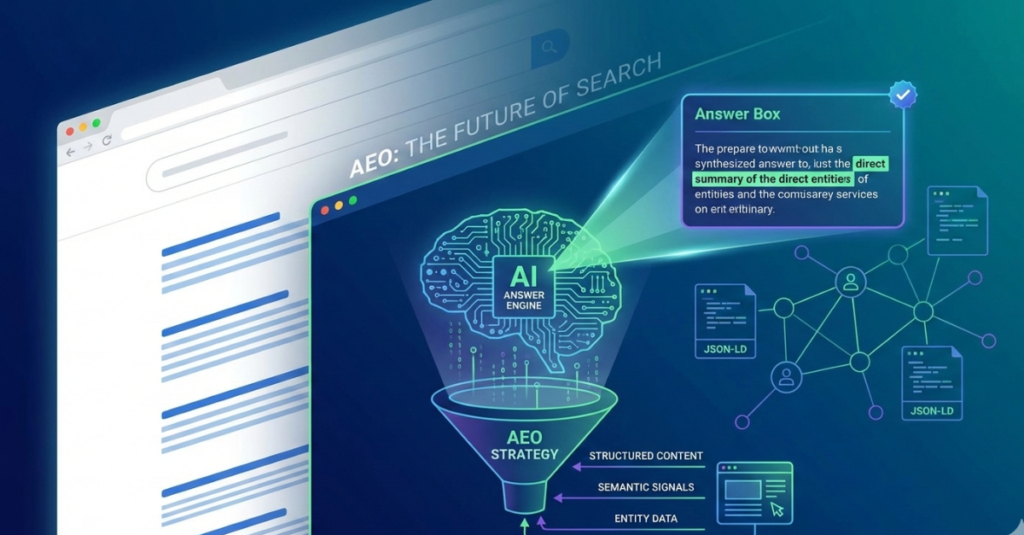
The online environment is undergoing a seismic shift that makes conventional search methods obsolete. Since the 1970s, the goal was to appear on the first page of blue links, but today’s users demand instant, synthesized answers.
This transition from clicking and browsing to receiving direct answers via Large Language Models requires a fundamental change in how you organize information. If your site fails to adapt, you risk losing visibility as AI-driven engines become the dominant way people access information.
SEO remains important, but Answer Engine Optimization (AEO) extends its reach for AI-driven environments like Perplexity and Gemini. This evolution isn’t just about keywords; it’s about building unquestionable authority and semantic clarity.
By adopting a machine-first data structure, your brand can remain a primary source of truth. This strategic shift is the only way to safeguard your digital presence against the next wave of search invisibility.
How Does Answer Engine Optimization Differ From Traditional SEO
Traditional SEO vs. AEO
Traditional SEO focuses on ranking links through keywords and backlinks, essentially acting as a popularity contest. AEO, however, is an audit of authority that provides specific answers for AI models to synthesize. Key Differences:
- Traditional SEO: Prioritizes link volume and search density.
- AEO: Focuses on verifiable facts and context window optimization for Knowledge Graphs.
Modern AI crawlers prioritize websites that minimize noise. If your information is buried under layers of fluff, AI will skip your site for a competitor with a cleaner, more organized answer.
Restructuring your content into machine-readable formats is the best way to stay visible. Since internet gatekeepers have changed their language, pivoting to AEO is your primary safeguard against losing organic traffic.
Why Is Traditional Data Structure Failing To Capture AI Traffic
Unstructured data is the primary adversary of AI because it creates low confidence during information retrieval. When an AI agent scans a page – such as a business on Westheimer Road in Houston or in Fulton County – it looks for specific identifiers to verify relevance.
If your page’s technical structure is messy, the AI won’t accept your data as fact. This often leads to the AI hallucinating or simply choosing a different, more reliable source for its response.
Consider user intent in conversational search. Users no longer browse product lists; they ask for specific recommendations based on complex criteria. If your answer is buried in a general paragraph, AI will never detect it.
In this Zero-Click reality, if you aren’t mentioned in the AI’s response, you won’t get the traffic. To survive this high-intent environment, you must move toward a structured, machine-readable format.

What Role Do Specialized Tools Play in Restructuring Content
We have created a dedicated tool that can automatically convert text which can be read by humans to machine understandable data structures without writing code. The following is a further examination of the factors involved:
Automatic Entity Graphing
The plugin recognizes unique ideas in your text and connects them with the existing Knowledge Graphs. This can be done to make sure that AI models know your brand is an established entity and not a pile of text.
Context Window Optimization
Rearrange the responses to the unique token constraints and choices of current LLMs by structure, and get a higher citation rate with our tool. It makes sure that your answers are brief enough to be synthesized and presented by AI.
For instance, shortening product descriptions so AI can summarize them within token limits.
Real Time Schema Injection
Standard schema can be hard and strict, whereas our plugin adds dynamic JSON-LD which can change with search trends. This maintains your metadata in tandem with the current demands of the Google AI Overviews and SearchGPT.
How Can Entity Based Indexing Change Your Content Strategy
Entity-Based Indexing moves beyond simple text matching to understand individual concepts and their connections within a global Knowledge Graph.
For example, while ‘Jaguar’ was once a vague keyword, AEO uses unique IDs to distinguish between the animal and the car manufacturer. By defining these entities, you provide the clarity AI needs to quote your brand with confidence.
Such change demands a complete reconsideration of the manner in which issues are treated. Rather than determining the number of times a key word is used, you need to find out the quality of a relationship between entities. Our mapping is automated by our plugin, which means that all of your content is matched to known factual nodes. This will ensure that AI does not understand your brand wrong and enhance your topical authority. You may leave the guesswork of a machine to define your brand identity when you can do it explicitly.
Where Does JSON-LD Impact Your Topical Authority
JavaScript Object Notation of Linked Data (JSON-LD) is the main language that artificial intelligence follows to comprehend the scenario of a webpage. The following is a further examination of the factors involved:
Establishing Authoritative Authorship
The schema attributes that the plugin utilizes are the links between authors and their professional background and previous employment. This is directly kept in trust signals that AI models rely on to know which sources are safe and trustworthy.
Defining Semantic Relationships
Our tool informs the crawler of precisely what concepts are under discussion by the use of the property of mentions and about. This prevents any type of ambiguity and will make sure your content is placed in the right category within the internal map of the AI.
Maximizing Snippet Eligibility
Properly implemented JSON-LD will qualify your content as one of the first to be shown in the search results provided by AI. This is the new Position Zero, and it is the secret of a high conversion rate.
When Should You Transition To An Automated AEO Strategy
The window to dominate the Knowledge Graph is closing as AI models finalize their lists of trusted sources. Once a model identifies a brand as the authority on a topic, that brand becomes part of the training data.
It’s significantly harder to dislodge an established incumbent in an AI’s memory than it is to surpass a competitor in traditional search. Waiting until your traffic declines might mean it’s already too late to recover.
Application of the AEO strategy today guarantees that your brand is in the future of the internet. The textbot will convert old articles into new AI-ready artifacts, which you can retroactively update on all of your content using our proprietary plugin.
It is not just a slight enhancement, but an AEO is a strategic adaptation that ensures relevance in the AI-driven decade ahead. By doing it now you are assured of becoming a pioneer in the era of answer engines. The successful digital adaptation is characterized by efficiency and foresight.