
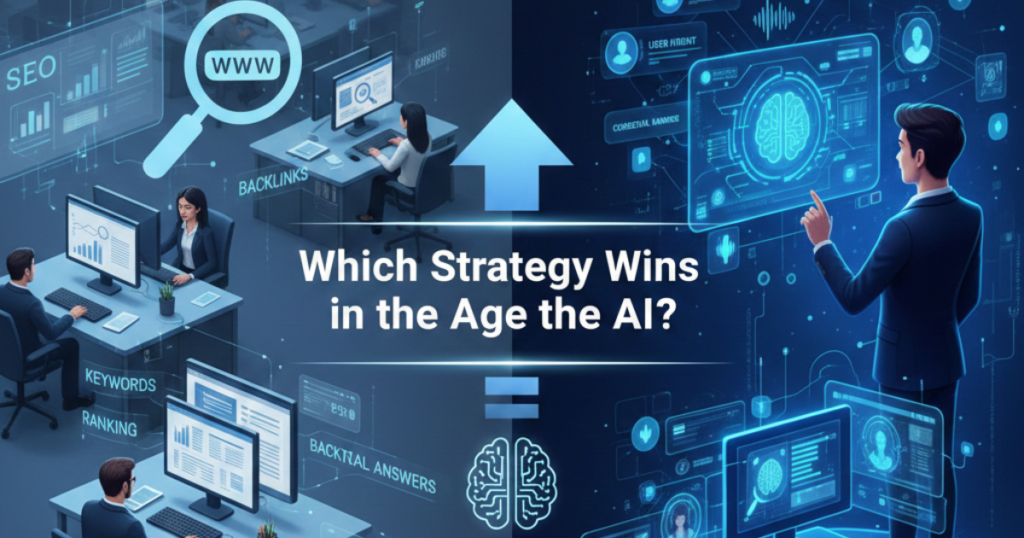
Search Engine Optimization (SEO) has been the undeniable foundation of digital marketing for decades. But nowadays with the emergence of Large Language Models (LLMs) such as ChatGPT, Claude, and Gemini, a new competitor has been introduced: Answer Engine Optimization (AEO).
You aren’t alone if you’re deciding between traditional search and answer-based visibility. As an AEO specialist, I’ve seen the shift from ‘searching’ to ‘asking’ directly transform business ROI. This change is fundamentally altering how customers find and interact with brands online.
We are going to deconstruct both mechanisms in this guide, discuss their strong suits, and show why AEO no longer qualifies as optional in 2026.
Understanding the Fundamentals: SEO vs. AEO
Before determining the better one, it is necessary to define the playing field.
What is SEO?
SEO ensures your site ranks highly on Search Engine Results Pages (SERPs) by focusing on three core pillars:
- Keywords: Targeting the terms users type into search bars.
- Technical Health: Ensuring your site is fast and crawlable.
- Authority: Building trust through backlinks and quality content.
The goal is to drive traffic to your site so users can consume your content or buy your products.
What is AEO?
AEO is the next step in SEO’s evolution. It streamlines your brand’s information so AI engines like Perplexity, SearchGPT, or Gemini can synthesize it into direct responses. Instead of just chasing clicks, the goal is to become the ‘origin of truth’ that AI models cite when answering user questions.
The Core Differences: A Side-by-Side Comparison
| Feature | SEO | AEO |
|---|---|---|
| Platform | Google, Bing, DuckDuckGo | ChatGPT, Claude, Gemini, Perplexity |
| User Intent | Browsing, comparison, research | Immediate problem-solving, specific queries |
| Goal | Click-Through Rate (CTR) and Rankings | Mention Share and Brand Attribution |
| Content | Long, dense in keywords | Concise, structured, factual |
| Currency | Backlinks and Domain Authority | Data fragments and Knowledge Graphs |
Why SEO Still Matters (The Foundation)
The concept of traditional SEO is not completely dead. It is the framework of your online presence. An AI has nothing to crawl without a technically sound website and quality content.
- High-Intent Research: With complex B2B sales or high-ticket items, users would still prefer to navigate several pages, read whitepapers and view the sections of About Us.
- Top-of-Funnel Branding: With SEO, you can attract general attention by providing general How-to guides and news about the industry, which create long-term brand equity.
- Visual and Local Search: In case of a physical business, the most common type of search on Maps is SEO (or Local SEO).
The Rise of AEO: Why the Paradigm is Shifting
As an AEO provider, I help brands realize that clicking is now a secondary behavior. Customers want instant solutions. If an AI agent recommends a specific CRM to a startup founder without them needing to open ten tabs, the brand the AI suggests wins the customer immediately.
1. The Death of the “Ten Blue Links”
The search experience (SGE) of Google and other AI search engines are driving organic results further down the page. Unless you are optimized to be at the top of the AI summary, you are literally not seen by a sizable proportion of mobile and voice-search users.
2. Zero-Click Searches
AEO leverages the zero-click phenomenon. For example, if a user asks how to clean a silk tie, an AI might provide a four-step tutorial instantly. By providing the data that powers that answer, your brand becomes the trusted voice behind the solution without the user ever needing to click a link.
3. Conversational Context
AEO is predicated upon long-tail and conversational searches. The traditional SEO can be often confused with the keenness of a conversation. AEO makes sure that you become a brand that is recommended when a user poses follow-up questions in an AI chat system.
How AEO Services Transform Your Brand Visibility
When we apply AEO to our clients, we are no longer just stuffing our key words. Our area of interest is in Information Architecture. The difference between the process and the traditional ones is the following:
Structured Data and Schema
Schema Markup is of great importance to AEO. We put the content of your site into one that can be easily digested by AI models. The way of telling the AI what your price is, who your founder is, and what problems your product solves, is by using JSON-LD.
The Snippet-First Content Strategy
We break down your pre-existing material into units of atoms. We do not put an answer in the fifth paragraph of a 2,000-word blog post, but rather start with brief and undecorated statements that can be easily extracted and quoted by AI models.
Building Entity Authority
AI does not simply examine keywords, but entities. We are trying to bridge your brand to the industry nodes relevant to the global Knowledge Graph. This is so that when an AI thinks about your industry, your brand comes to mind as one of the first things it thinks of.
SEO vs. AEO: Which is “Better”?
The honest answer? AEO is the superior investment in the long term, but it needs SEO to work.
When you are focused on SEO only, you will lose the huge portion of the market that moved to AI chatbots. When you narrow down to the traditional searchers who still love browsing it, you will lose them to AEO.
But when you want to talk of competitive advantage, then it is AEO that the Blue Ocean is. The majority of your competitors are still trying to occupy the 1st place on Google. Few of them are fine-tuned to become the first thing to be quoted in a ChatGPT reply.
The Verdict: AEO will be superior to use in terms of conversion and authority in a modern setting, whereas SEO will be the superior tool as far as broad discovery is concerned.
Adoption of a Hybrid Strategy
It is not necessary to pick one or the other. Actually, the most successful of our clients apply an integrated approach.
Step 1: Technical SEO. Make sure that the site is crawlable and fast.
Step 2: AEO Content Layer. Include FAQs, TL;DR summaries, and formatted data on every page.
Step 3: Authority Building. Earn citations and mentions on credible platforms that AI models rely on as training data or live references.
The Future: Being the “Chosen” Answer
We foresee the AI agents to be able to perform the majority of the routine search tasks in the next 24 months. The users will query their phones to find the best-rated organic dog food in Chicago and the AI will then decide on the available data.
Unless you optimize your data to be Answer Engines, you will not be in the game. As an AEO provider, I plan to make sure that your brand is not simply present on the internet, but rather the first choice given by the smartest systems in the world.
Conclusion: Don’t Wait Until Search Ends
The shift from SEO to AEO is the most pivotal moment in digital history. While SEO gets you to the party, AEO keeps you in the conversation. You’ll safeguard your brand’s future in an AI-driven world by optimizing for the way people ask questions today.
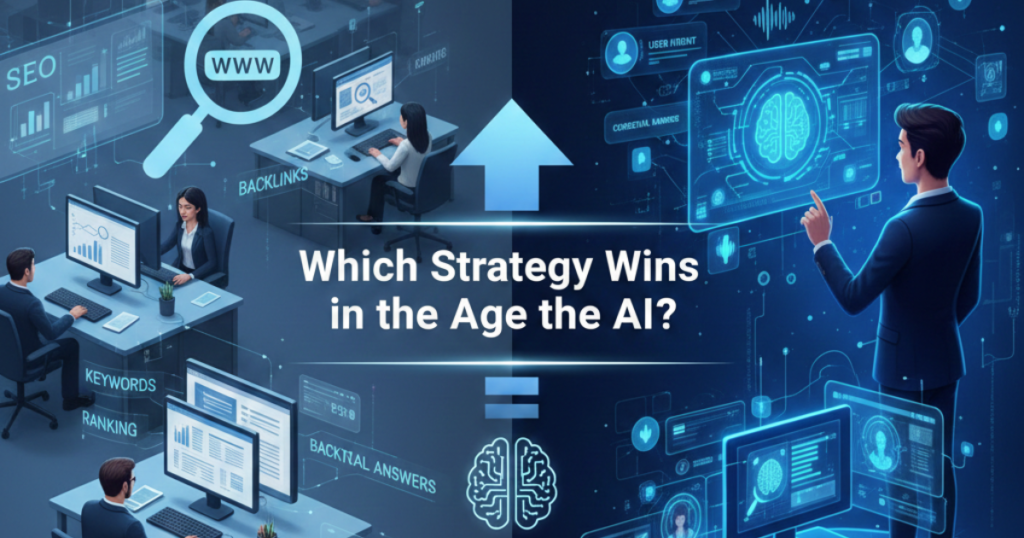
You are prepared to quit clinching a fight, but become the antidote?
How we Can Help You Lead the AI Revolution
Being an expert in Answer Engine Optimization, We do not simply rank websites but embed them into AI models. We can help you:
Do an AEO Audit to determine the current perception of your brand by AI.
Feed Knowledge Graph with Advanced Schema.
Repurpose your high-value content to Maximum Citability.
Would you possibly have me do an initial AEO analysis of your site to determine how AI models are ranking the information about your brand at this point?