

The digital search environment shifted when Large Language Models began synthesizing answers rather than simply listing blue links. If your content isn’t surfacing in these AI responses, your brand essentially doesn’t exist for a massive segment of modern users who now bypass traditional search engines entirely. Why settle for being a buried search result when you can be the definitive source of truth at the very top of a generated chat? Earning a citationand truly mastering how to get cited in ChatGPT answers requires more than standard optimization; it demands a fundamental shift toward Answer Engine Optimization (AEO).
This isn’t just about keyword density anymore; it’s about information architecture and semantic relevance. As these models move from simply predicting the next word to reasoning through complex data, your content must be structured to meet them halfway. Success lies in making your data so clear, authoritative, and technically accessible that an algorithm can’t ignore its utility. By aligning your digital footprint with the way AI identifies truth, you move from being a ghost in the machine to a primary cited reference.
The Evolution: Traditional SEO vs. AI Optimization
To understand how to get cited in ChatGPT answers, you first have to understand that the rules have changed. We aren’t just ranking for humans anymore; we are formatting for a machine’s confidence score.
| Feature | Traditional SEO (Google) | AI Optimization (AEO) |
| Primary Goal | Rank in Top 10 Blue Links | Become the Primary Source/Citation |
| Content Focus | Keywords and Backlinks | Entity Relationships & Fact Density |
| Structure | Blog Layout / UX | Semantic HTML & JSON-LD Schema |
| Metric for Success | Click-Through Rate (CTR) | Inclusion in LLM Synthesized Response |
| Tone | Engaging / Narrative | Declarative / Authoritative |
Why Does ChatGPT Choose One Source Over Another?
Algorithms prioritize clarity, accuracy, and ease of extraction. When a user asks a complex question, the AI scans vast datasets to find a response that is both comprehensive and easy to parse. It isn’t looking for flair or filler; it’s looking for the most direct path to a factual answer. If a webpage presents information in a cluttered or ambiguous way, the model will likely skip it in favor of a competitor who uses precise language and structured headers.
Think of it like a librarian who only suggests books with the best indexes. It’s all about accessibility. Furthermore, the model evaluates the reliability of the source through established entity relationships. If the web of data surrounding your brand suggests you’re a leader in a specific niche, the likelihood of a citation increases. This isn’t just about keywords anymore; it’s about being an entity that the AI recognizes as authoritative.
High-quality citations often go to sites that provide unique data points or specialized insights that aren’t found in generic AI training sets. By offering distinct, data-driven value, you position your site as an essential resource that the model must reference to provide a complete answer.
How Do You Structure Data for LLM Consumption?
Optimizing for AI requires a shift from writing for humans alone to writing for sophisticated machines that crave structure. These models process information by identifying patterns and relationships between different pieces of data. If your page is a messy sprawl of text, the AI will struggle to determine which part of your content actually answers the user’s specific query. To ensure your insights are selected, you must use technical signals that highlight your most valuable information.
This process involves a combination of backend code and frontend formatting that works in harmony to signal relevance and authority to the search crawlers and AI agents. By organizing your content into a hierarchy that mimics how LLMs categorize information, you significantly improve the chances of your brand appearing as a cited reference in real-time generations.
The following techniques represent the fundamental building blocks of a robust AEO strategy, ensuring your site remains visible in a changing digital world. Consider these technical adjustments to better align your site’s architecture with modern machine learning requirements:
Implementing Schema Markup for Enhanced Context
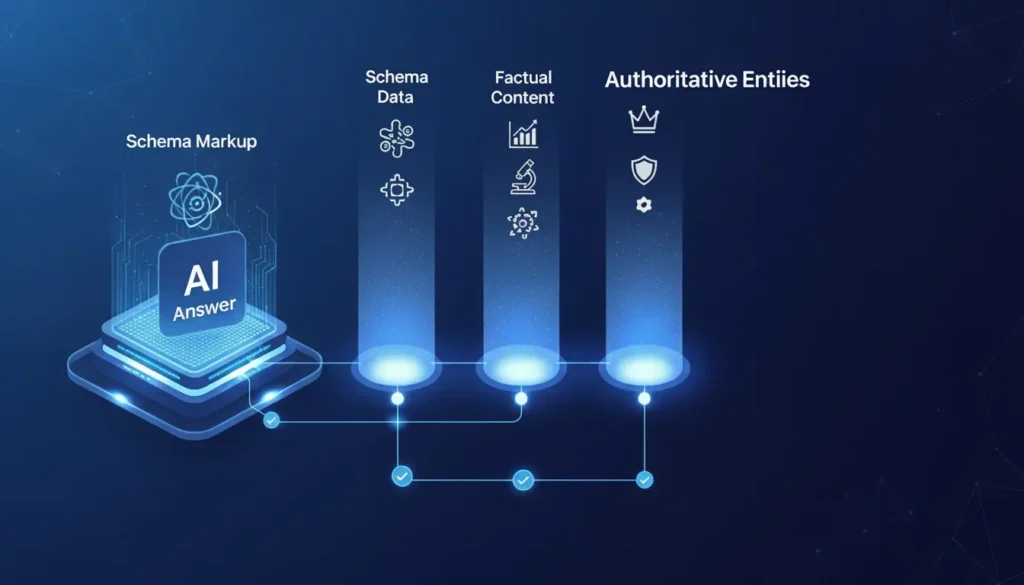
Schema markup acts as a digital translator between a website and the AI models scanning it. By using specific JSON-LD tags, you provide explicit definitions for your content, identifying what a product, an FAQ, or a professional biography is.
This removes the guesswork for the algorithm, allowing it to understand the relationship between different entities on your page. When the AI doesn’t have to guess what your data means, it is far more likely to trust that information and use it as a primary source for a generated answer. Precision in your backend metadata is the foundation of modern visibility.
Utilizing Semantic HTML for Logical Hierarchy
Semantic HTML tags like article, section, and aside tell the AI exactly how your content is organized. While standard tags might display text correctly for a human reader, semantic tags provide a map for the machine. This hierarchy helps the model identify the most important parts of your message and how sub-topics relate to the main theme.
Using these tags effectively ensures that the AI can quickly locate the specific paragraph that answers a user’s question. Clear structure leads to higher confidence scores from the algorithm, which directly translates into more frequent citations across various generative search platforms.
Formatting Lists and Tables for Instant Extraction
AI models are highly efficient at extracting data from structured formats like bulleted lists and tables. These elements break down complex information into bite-sized, digestible pieces that are easy for an LLM to incorporate into a synthesized response. If you present a comparison or a set of steps in a table, the AI can reference that data directly with minimal processing power.
This convenience makes your content a preferred source. Instead of making the machine work to summarize your long paragraphs, you provide the summary yourself, making it nearly impossible for the model to overlook your site.
What Role Does Brand Authority Play in AI Citations?
Brand authority in the era of AI is less about raw traffic and more about how your brand is perceived within a global knowledge graph. AI models don’t just look at your site; they look at what the rest of the internet says about you. They analyze mentions, citations, and relationships across various platforms to determine if you are a credible source of information. This holistic view of your digital footprint determines whether you are considered a trusted entity or just another anonymous webpage.
Building this authority requires a consistent presence across multiple high-authority domains and a clear association with your core topics. When an AI searches for an answer, it cross-references its training data with live web results to find the most reputable expert. If your brand is frequently mentioned in professional contexts and linked to specific industry solutions, the AI will prioritize your content. Strengthening these digital associations is a long-term play that yields significant rewards in the form of persistent citations. The following strategies help solidify your standing as a primary authority:
Establishing Entity Relationships via Knowledge Graphs
A knowledge graph is a network of entities and their interrelations. To get cited, your brand needs to be a recognized node in this graph. This is achieved by ensuring your information is consistent across Wikipedia, LinkedIn, and industry-specific directories. When an AI sees your brand consistently linked to specific high-value keywords, it builds a trust score for your entity.
This score is a major factor in whether the model chooses your site as a source. Consistent, verified information across the web makes your brand a reliable reference point for the machine.
Building Backlinks from AI-Preferred Educational Domains
Not all backlinks are equal in the eyes of an LLM. Links from educational institutions, government sites, and established industry journals carry immense weight. These sources are often heavily weighted in the initial training sets of models like ChatGPT. When these seed sites link to your content, it signals to the AI that your information is academically or professionally sound.
This type of endorsement is far more valuable than a hundred low-quality blog comments. Focusing on earning mentions from high-trust domains creates a digital trail that leads the AI directly back to your expert content every time.
When Should You Prioritize Information Density Over Length?
The era of 3,000-word blog posts filled with fluff is coming to an end. AI models prioritize information density, which is the amount of useful data provided per sentence. If a user asks a question, the model wants to provide the most concise and accurate answer possible. If your content is buried under layers of unnecessary introductions and repetitive transitions, the AI will find it inefficient to process.
Instead, focus on front-loading your content with facts, statistics, and direct answers. This approach makes your text more scannable for the algorithm, increasing the likelihood that it will pull a direct quote from your page. Many professionals believe the myth that longer content always ranks better, but in the realm of AI, this is often false. High information density doesn’t mean your content should be short, but it does mean every sentence must serve a purpose. Consider the ratio of signal to noise.
A shorter article that provides five unique, data-backed insights is more valuable to an AI than a long guide that repeats common knowledge. By providing dense, high-value information, you cater to the AI’s need for efficiency. This shift in strategy ensures that your content remains the preferred choice for models programmed to respect the user’s time.
Why Traditional SEO Tactics Fail in the Age of Generative AI?
Many professionals still cling to the belief that high keyword density is the key to ranking. In reality, modern LLMs are far more concerned with intent and context than with how many times a specific phrase appears on a page. Traditional SEO often relies on gaming the algorithm through repetitive wording and aggressive backlinking, but AI models are designed to see through these thin tactics.
They can detect when content is written primarily for a search engine rather than for a human seeking a solution. If your strategy is still focused on hitting a keyword quota, you’re missing the nuances of semantic search. Furthermore, the blue link era was about driving clicks to a page, while the AEO era is about providing the answer within the search interface. If your content isn’t structured to be summarized, you won’t get the citation.
Traditional SEO often ignores the technical structured data that AI models use to verify facts. Without this layer of machine-readable information, even the best-written content can remain invisible to a generative model. Adapting to this new reality means moving beyond old-school metrics and focusing on how well your content functions as a data source for an intelligent system. It’s about being useful.
Frequently Asked Questions
What is the most effective way to get cited in ChatGPT answers?
The most effective method is implementing Structured Data (Schema markup). By using JSON-LD to explicitly define your content as an FAQ, Article, or Dataset, you provide the machine-readable roadmap that AI models need to verify and extract your information as a primary source.
Does content length affect how it is cited in ChatGPT answers?
Yes, but not in the way traditional SEO does. AI prioritizes information density over word count. To increase your chances of being cited, focus on Fact-First writing, eliminating fluff and placing direct, declarative answers at the beginning of your sections.