
The search landscape has shifted from clicking links to receiving direct answers. For decades, SEO focused on placing ten blue links on a page, but that model is crumbling.
AI search tools like ChatGPT, Google SGE, and Perplexity have transformed the user experience. Users no longer just search and click; they ask and receive synthesized information instantly.
We have come to the era of the Answer Engine.
The algorithms in this new ecosystem do not merely match the keywords but synthesize information. They are also research assistants and read various sources to offer one conclusive answer. This is a dramatic question to businesses: Would AI place its trust in your brand, or is your business unseen?
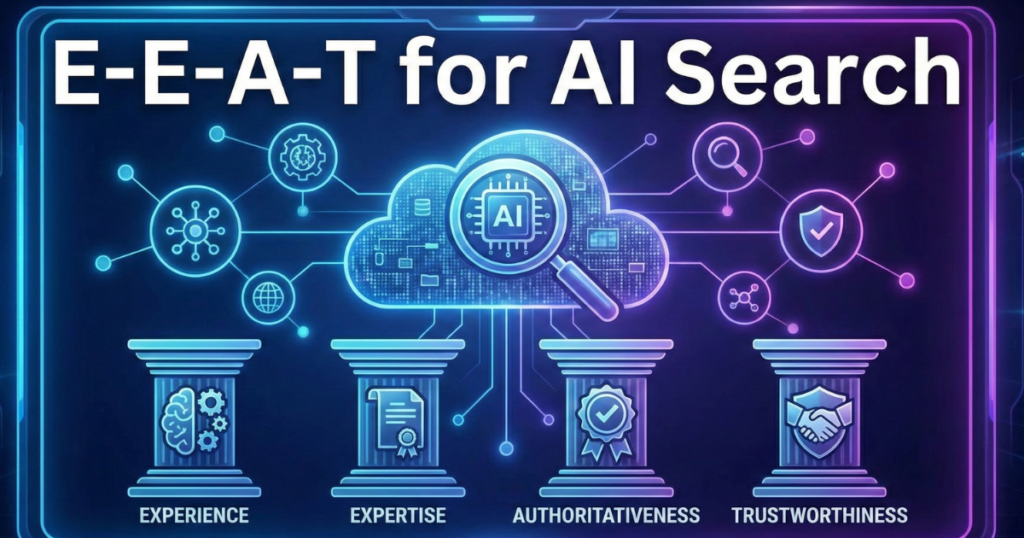
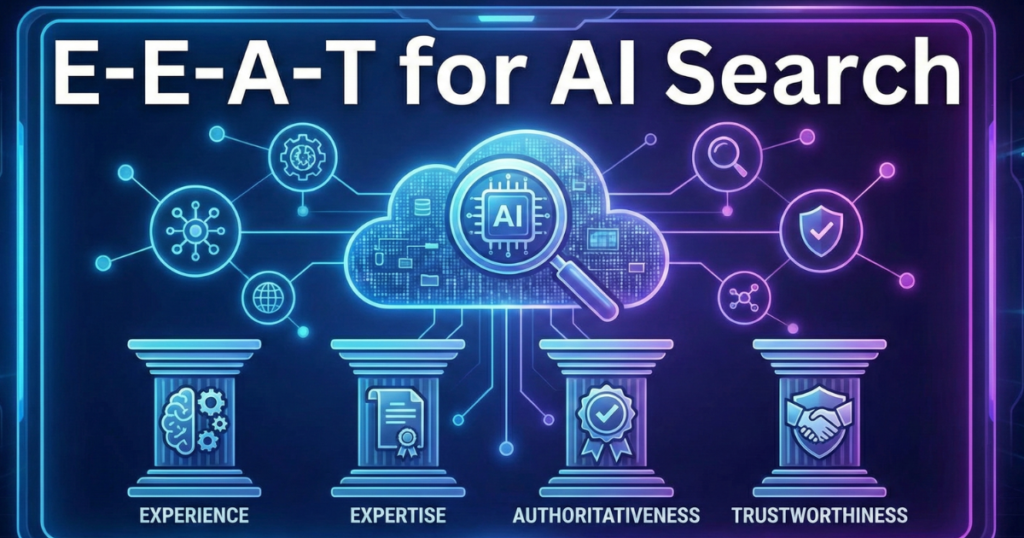
It is no longer only the density of the keywords or the number of the backlinks. It is E-E-A-T for AI Search Experience, Expertise, Authoritativeness, and Trustworthiness in the machine age.
It will discuss the role of E-E-A-T in defining visibility in the AI era, the workings of the entity-based search engine optimization, and the reason your business should have its unique AEO (Answer Engine Optimization) strategy to survive and prosper.
The Evolution: From Blue Links to AI Answers
Before we see the need of E-E-A-T in the search of AI, we should discuss how answer engines are different than the traditional search engines.
The conventional search engines behaved as librarians. You request a book on cloud computing, and they refer you to the shelf (the SERP). You need to open the books (follow the links) to get the answer.
Answer engines (such as SearchGPT and Gemini) resemble researchers. The question is, what is the optimal cloud computing environment of a mid-sized healthcare company? The AI reads the books on your behalf, confirms the facts, and composes a summary.
The “Citation Economy”
In the new citation economy, traffic comes from being mentioned rather than just ranking first. When an AI generates an answer, it looks for ‘truth pillars’ to support its claims.
If your content lacks strong E-E-A-T signals, the AI will likely dismiss it as noise. You must establish your brand as a reliable information source to be included in these AI-generated responses.
It is here that Answer Engine Optimization (AEO) is applied. AEO is the technical and creative art of structuring your authority in such a way that AI models can simply read, comprehend, and reference your brand.
Deep Dive: E-E-A-T for AI Search
The E-E-A-T framework developed by Google was initially aimed at human quality raters, which is why it is the guide today to the filtering of truth and hallucination by Large Language Models (LLMs).
1. Experience: The Blind Spot in the AI.
An artificial intelligence model is exceptional in data processing, and it lacks any real-life experience. They are new to using an SaaS product, visiting a store, and dealing with a crisis. And this is your competitive advantage.
In order to appear in the search results of SGE or ChatGPT, your content has to show that you have had experience in something that cannot be replicated by an AI.
The Shift: Get off of generic how-to guides that are a regurgitation of Wikipedia.
The Strategy: Post case studies, “I tested this” reviews, and stories that contain proprietary information or failures.
AEO Signal: Terms such as “in our study of 500 clients,” etc., or When we put in this patch… indicate to the AI that this data is first-hand information, not a duplicate of an image.
2. Proficiency: Expertise Depth Over Breadth.
Previously, websites were able to rank on a shallow search of general subjects. This is punished by AI search marketing. The LLMs are trained on billions of parameters; they have already received the fundamentals. They appreciate rich and multifaceted expertise.
Expertise in AEO requires deep semantic coverage of your topic. For example, an expert writing on Enterprise Cybersecurity should discuss related entities such as:
- Zero-trust architecture
- ISO certifications
- Threat vectors
Covering these specific concepts proves to the engine that you’re a subject matter expert, not just a keyword stuffer.
3. Authoritativeness: The Who of it Matters.
Who is writing your content? Like in AI-generated spam, a clear authorship has become one of the leading quality filters.
Author Profiles: All content must be connected to a powerful author profile that includes credentials, LinkedIn connections, and previous work.
Brand Authority: Does your brand receive some mention by other authoritative bodies? Whenever you are mentioned in the Wall Street Journal or some other industry paper, the Answer Engines place a stronger confidence rating on your facts.
4. Reliability: The condition
The “T” that keeps the others together is trust. In the case of AI search, trust is technical.
Precision: AI models intersect facts. In case your content conflicts with the consensus, and that conflict is not based on hard evidence, it can be marked as a hallucination risk.
Security: HTTPS, explicit privacy policies, and open affiliate disclosures have ceased to be a luxury; they are now mandatory ingredients to be a part of the knowledge set of the AI.
Entity-Based SEO: The Language of AI.
Keywords are strings of text. Things are entities, people, places, concepts, and ideas.
While humans search with keywords, AI uses entity-based SEO to understand context. A traditional engine simply matches the letters ‘a-p-p-l-e’.
In contrast, an AI reads the surrounding context to determine if you mean the fruit or the technology company. This distinction allows the machine to provide more accurate, context-aware answers.
Knowledge Graph Relation.
AEO will have the goal of making your brand and your authors known in the Knowledge Graph.
Entity Silence: This is the extent to which something matters to the text. You have to explain how to relate your brand (The Provider) and AEO (The Service) through the structured data in order to rank with AEO Services.
Semantic Connections: Plotting Topic Relationships
AI calculates relevance by examining the ‘distance’ between different concepts. To build authority, your content should address related subjects such as:
- SEO and Schema Markup
- LLMs (Large Language Models)
- Voice Search
Establishing these correlations helps the AI understand the full scope of your expertise.
Our AEO Service Approach: Optimizing Digital Identity
We go beyond text optimization to refine your entire digital identity. By adding complex schema markup, we tell machines exactly what your brand does and which problems you solve.
This technical clarity eliminates ambiguity, placing your brand directly in the path of AI-generated answers.
The AEO Strategy: Zero-Click Future.
Conventional SEO is concerned with securing a click. AEO is about being the answer. As Google SGE moves the organic links further down the page, it is either you are in the AI snapshot top or not.
The following is our strategic plan that we use to prepare our clients to master E-E-A-T to Search AI:
1. The Content Structure: The Inverted Pyramid.
AI models operate linearly on a text but positively focus on the start. We format information in such a way that the answer is immediately given to us, which we commonly refer to as BLEF (Bottom Line Up Front).
AEO Optimized: Direct Answer (Trying to get the Featured Snippet) -> Supporting Evidence -> Minutiae.
2. Questions and Answers (Q&A).
Individuals do not talk to AI like they do when making a query on Google. Inquiries are getting longer and more colloquial.
Old Query: “best crm”
New Query: What is the best CRM for a small real estate company that will integrate with Slack?
Optimize for long-tail conversational queries by adding specific Q&A sections to your content. This strategy improves your chances of being selected by voice assistants and ChatGPT search.
3. Structured Data and Schema
It is the code that converts your content to machine language. You are relying on the AI to be able to decipher you without a strong schema. In the case of schema, you are informing the AI about yourself.
We implement:
Organization Schema: To entrench brand authority.
Person Schema: To check the authority expertise (which is essential in E-E-A-T).
FAQ and Schema: To divide content into easy-to-digest bites that can be displayed to the answer engines.
4. Data-Driven Authority
To gain trust, you must become a ‘truth teller’ by publishing original data. We help brands create citation magnets, including:
- Proprietary statistics
- Original research
- Technical white papers
When other sites cite your data, AI engines view you as a central node of information. This significantly boosts your visibility in SGE and other generative search reactions.
The Reason Behind Why Traditional SEO Is Not Sufficient Anymore.
Numerous companies believe that the current marketing firm does this. Regrettably, the majority of the traditional agencies are still functioning through the 10 blue links model. They are search engine oriented and unconcerned with the semantic and entity-based cues that are demanded by AI.
When you do not consider answer engines in your strategy, you are maximizing a declining pie.
The conventional SEO brings the visibility of searchers.
Machines and searchers are brought into the limelight by AEO Services.
The gap between optimized and unseen brands will widen as AI search marketing matures. Brands that ignore AEO risk being forgotten, as users increasingly rely on AI rather than visiting traditional websites for answers.
Conclusion: Future-Proof Your Visibility.
The adoption of AI-driven search is not a trend; it is the biggest change in digital marketing since the creation of the search engine. The measures of success have fluctuated. It is not only about the volume of traffic anymore; it is also about the brand authority and citation rate.
You need to be highly E-E-A-T, use entity-based SEO, and have a technical SEO strategy providing alignment to how machines process the world in order to be successful.
Your Next Step
Your brand has the expertise. It is a matter of how that expertise can be converted into a language that AI search engines would believe and give priority to.
Are you ready to adapt?
Our focus is on switching progressive organizations to a more advanced form of AEO and AI search marketing. We do not simply rank you out; we give you the response.