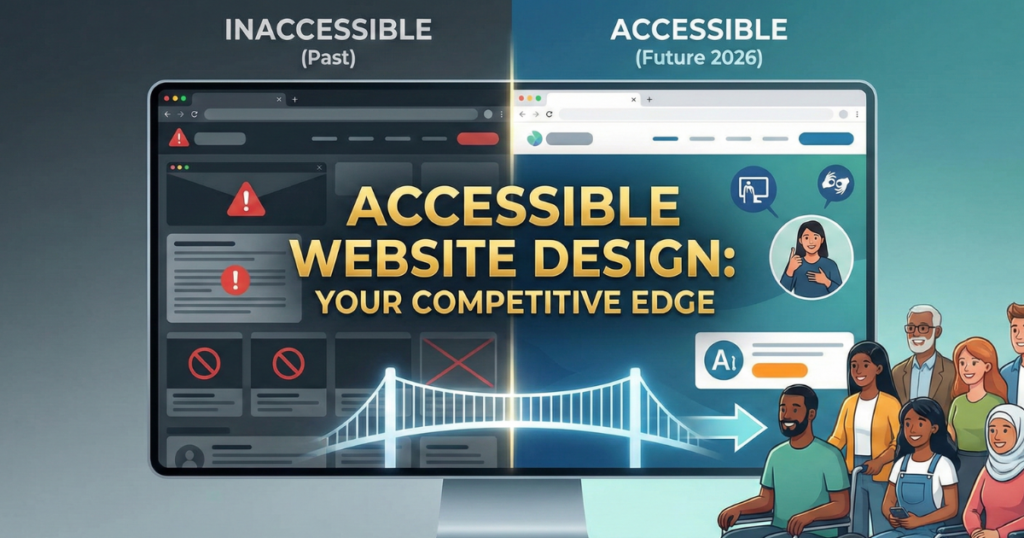
The definition of a high-performing website has changed in the fast-changing digital environment of 2026. A slick interface and high load speeds are no longer sufficient. The most successful digital assets today share one trait, which is inclusivity through Accessibility Friendly Website Design.
The design of a site that can be accessed by people with disabilities, usually considered a simple checkbox in the previous era, has become a key factor of SEO supremacy, brand recognition, and an increase in revenues. Accessibility no longer revolves just around doing what is right, as search engines such as Google are now strongly emphasizing user experience (UX) indicators, and AI-based search is deemphasizing unclear and unstructured content. It is all about making your business live and prosper in the competitive digital economy.
Unless your site targets all audiences, you are literally shutting your virtual doors to almost 20% of the international population. This is why accessibility friendly website design is the wisest investment you can make this year, and why our agency is in the best position to help you through it.
What is Accessibility-Friendly Website Design?
In its simplest definition, accessible web design is the approach where websites, tools, and technology are designed and developed in a manner such that persons with disabilities can use them. This includes:
- Auditory: Supporting the deaf or the hard of hearing (e.g., captions, transcripts).
- Cognitive: Easy layouts and language for individuals with learning disabilities (e.g., dyslexia, ADHD).
- Neurological: Prevention of triggers of seizures and predictable navigation.
- Physical: Making it possible to lose the use of a mouse (navigate using a keyboard) for individuals with motor issues.
- Visual: Screen readers, braille, and high-contrast visual impairment support.
There is also accessibility in 2026 for the so-called situational disabilities. Such as assisting a user who is on a bumpy train ride, a parent who has a baby and is browsing with one hand, or a user who is in the sunshine and is looking at your site.
The SEO Advantage: How Accessibility Boosts Rankings
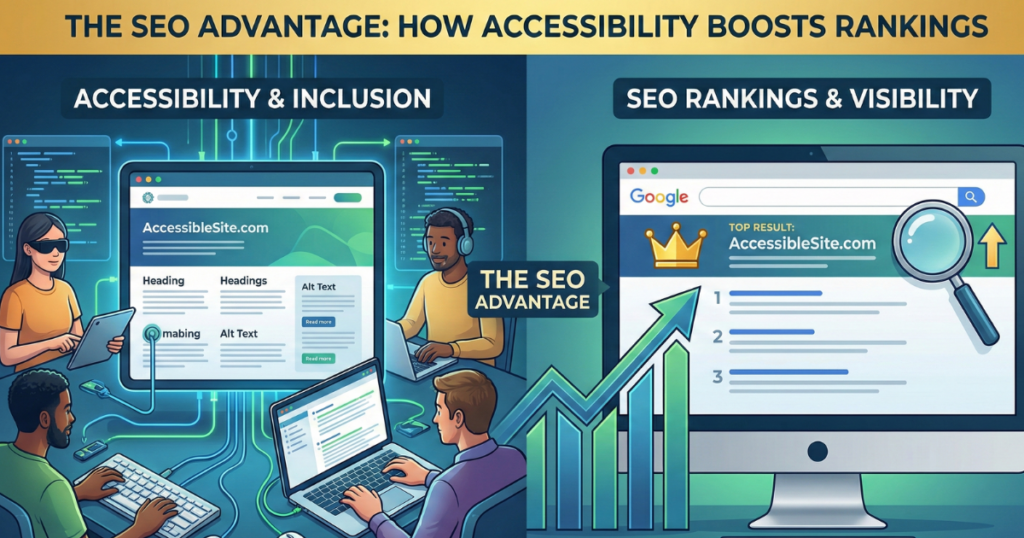
Accessibility is directly related to Search Engine Optimization (SEO), which is one of the most convincing business arguments to make. The algorithm used by Google has become extremely advanced, with the adoption of AI to read and comprehend websites as a human being would.
1. The Principle of “Google is Blind”
Search engine crawlers are “blind” users of the search engine. They use the same technical structures used by screen readers to comprehend what you have to say.
- Alt Text: By providing descriptions that are accessible to the visually impaired, we are also providing Google with juicy, contextual keywords on your visual content.
- Hierarchy (H1-H6): A logical hierarchy serves to filter readers through your site and filter search bots through your content, improving the visibility of your long-tail keywords.
2. Voice Search Compatibility
Semantic HTML is king with the burst of voice search and intelligent assistants. Your voice assistants can understand your content easily when it is accessible (such as via Schema markup and ARIA labels). In case your site is made accessible, then it is optimized for the search of the future.
3. User Experience Metrics (Core Web Vitals)
Google ranks its sites according to user interaction. Unreachable pages confuse the user, and it results in “pogo-sticking” (clicking your link and going back to Google). High bounce rates inform search engines that your site is poor. With easy navigation for all, you will maximize time and engagement indicators, which will give you greater authority as a domain.
The Legal & Financial Imperative
The business environment on the issue of digital accessibility has become more restrictive.
- The Stick: There are more lawsuits and compliance requirements (ADA and the European Accessibility Act, respectively); in 2026, the risk is higher than ever before. Companies are no longer receiving warning notifications; they are paying significant sums of money and losing reputation due to non-conformity. Lack of knowledge is no longer a defense in court.
- The Carrot: The “Purple Pound” and the disability market worldwide hold more than 13 trillion dollars in disposable income. Businesses are missing out on huge revenues by not taking accessibility into account. A convenient e-commerce checkout process will not only accommodate disabled users, but it will also make the process easier for all users, making direct conversion rates of the process go up.
The Essentials of Our Proven Web Design
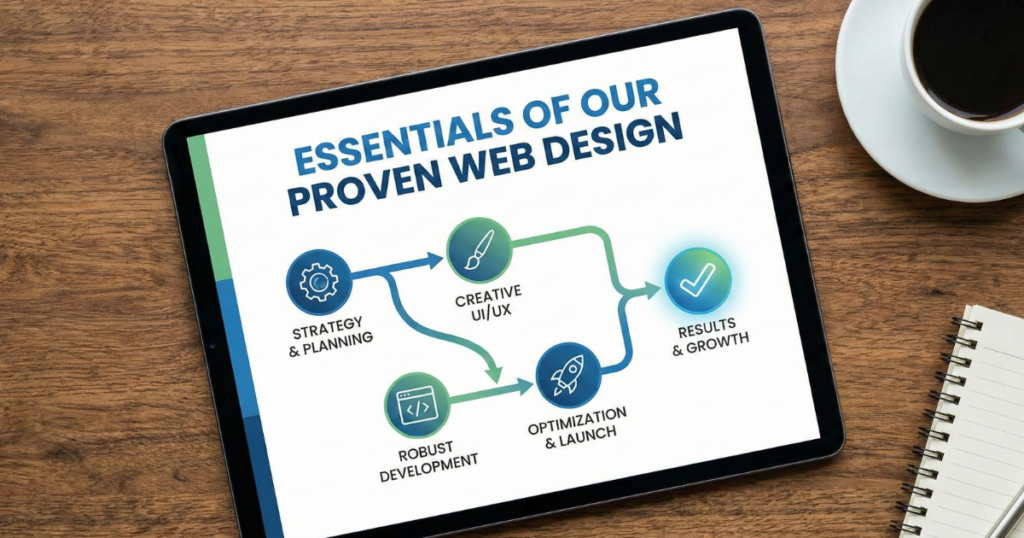
When we create a site, we do not simply perform an automated scan and call it a day. We create accessibility in your site’s DNA. Here is the way that practice looks:
WCAG 2.2 Compliance (Level AA & AAA)
We comply with the recent Web Content Accessibility Guidelines (WCAG).
- Contrast Ratios: We make sure that there is contrast between text and background so that low-vision or color-blind people can read.
- Focus States: We create visual cues to ensure that keyboard-only users are aware of their location on the page.
- Touch Targets: We create buttons and links with a sufficient distance between them (at least 44×44 pixels) to ensure that users with motor tremors can use them, making the mobile experience more enjoyable for everyone.
Semantic HTML & ARIA
We write clean and semantic code that is loved by assistive technologies. ARIA (Accessible Rich Internet Applications) landmarks are used only when absolutely needed to fill in gaps that cannot be addressed using standard HTML, ensuring that dynamic content (such as pop-ups and sliders) can be accessed completely.
Media Alternatives
We make sure that no video content is without support for closed captioning and audio descriptions, and that any informational image has descriptive and keyword-rich alternative text.
Why Choose Us? The “Shift-Left” Approach
Web design agencies are a hundred and one. Why do we deserve your online presence? Since other designers engage accessibility as an appendix or a cleanup process after the site is designed, we regard it as the basis.
1. We “Shift Left”
In software development, “Shifting Left” describes the placement of testing at the earliest phases of the process. We do not wait until launch day to test for accessibility.
- Design Stage: Our designers verify color contrast and font legibility before one line of code is written.
- Development Phase: Linting tools are used by our developers, which ensure inaccessible code is not committed.
- Output: A natural user experience, which is not a hack job.
2. Hybrid Auditing: AI and Human Knowledge
Automated widgets or overlays are the only tools that many agencies use. Caution: Automated tools detect approximately a third of access issues. We use a hybrid approach. We make use of the highest level of automated scanning to do a fast check, but we do manual auditing using experts to pick up the nuance. We test keyboard navigation, the way to handle errors on forms, and cognitive load the things that a robot cannot evaluate.
3. Real-User Testing
We employ the slogan: “Nothing about us without us.” There are testers with whom we collaborate who use assistive technologies (screen readers, switch devices, magnification software) daily. This makes sure that your site is not just technically correct, but actually usable and pleasant for people with disabilities.
4. Maintenance & Future-Proofing
The web changes daily. Accessibility can be broken by a browser update or a new upload of content. Your content team receives constant attention and training on how to keep the quality of the content and material that you have posted high. When you have a new blog post or product, you are certain how to keep it to the standard that we have set.
Conclusion: Being Innovative is Being Inclusive
In 2026, an unreachable website is a liability. It damages your search engine optimization, creates a legal threat, and puts off a huge number of customers.
By selecting us, you are not purchasing a website but rather investing in a digital property that is strong, legally defensible, and universally popular. You are opting to establish your brand as a progressive leader that respects each and every customer.
Are you ready to open up to the online world?