

Generative AI is now a vital business infrastructure, with over 85% of companies hosting models in production by 2026. The focus has shifted from whether to implement AI to how businesses can integrate it to drive actual ROI.
According to recent industry benchmarks, while early adopters have achieved an average 25% increase in operational throughput, almost 60% of AI projects have not yet made it out of the initial proof-of-concept stage because of integration friction.
As committed collaborators in Generative AI solutions, we have been direct participants in how Large Language Models (LLMs) and generative systems are rewriting the playbooks of efficiency, creativity, and customer relationships contributing to an estimated $4.4 trillion in annual global value.
The Evolution of Generative AI in Business
To determine the worth of Generative AI services, one must first consider the change in the role of technology. At the beginning of the 2020s, attention was paid to the “wow factor” of text and image generation. Now, the focus is on agentic workflows and integrated systems.
Generative AI is no longer just a chatbot on a website; it is the driving force behind:
Robotized Knowledge Management: Synthesizing decades of company records and documentation immediately for new employees.
Case Study: Knowledge Management Success
A global consumer goods leader used an AI assistant to let staff query shipping and account histories in plain language. This transformed data silos into conversational assets and reduced call-back times from ten minutes to just ten seconds.
Dynamic Supply Chain Analysis: Forecasting disruptions and creating alternative supply chain paths on demand.
Hyper-Personalized Marketing: Generating thousands of unique, brand-compliant creative assets for various demographics on the fly.
In order to take advantage of these capabilities, businesses require a partner who can see not only the code but the broader situation.
How We Deliver Generative AI Services
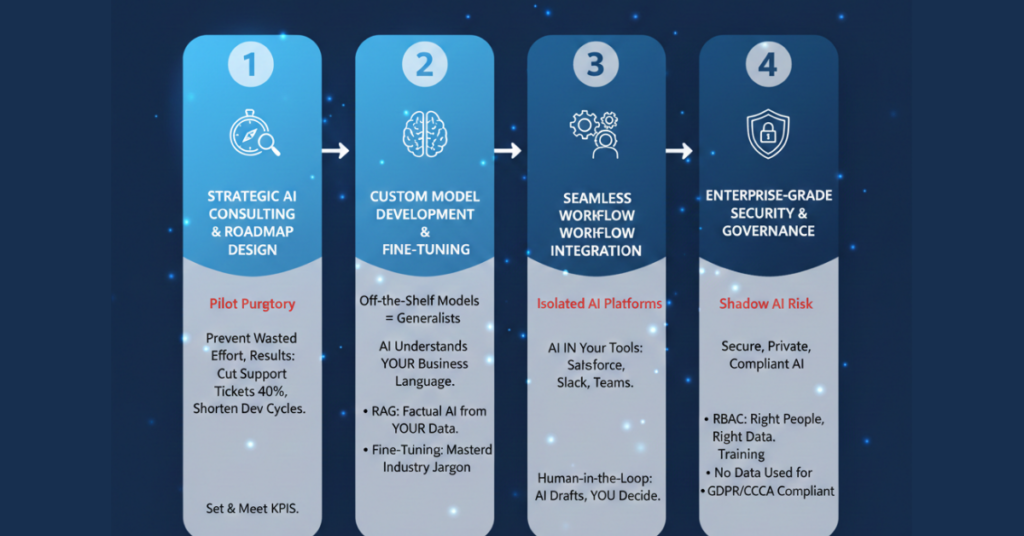
The premise behind our way of offering Generative AI solutions is based on the assumption that AI must be a tailor-made suit rather than a “one-size-fits-all” garment. Our service delivery falls under four different pillars that we classify under risk reduction and impact maximization.
1. Strategic AI Consulting and Roadmap Design
The problem for many organizations is “pilot purgatory,” which begins with zeal before AI projects ever reach production. Our AI consulting addresses this by starting with an intensive audit of your business pains and data infrastructure.
We don’t just ask, “What can AI do?” We ask, “What is the most costly issue that AI can address for you today?” Whether it is cutting customer support ticket counts by 40 percent or shortening software development cycles, we set specific KPIs and meet them prior to writing the first line of code.
2. Custom Model Development and Fine-Tuning
Standard models like GPT-4 are strong generalists but lack industry-specific context. For example, a legal AI must understand ‘tort’ differently than a bakery understands ‘torte.’ We solve this through two specialized methods:
- Fine-Tuning (FT)
- Retrieval-Augmented Generation (RAG)
- RAG Implementation: We link to your trusted internal data (PDFs, databases, intranets) safely. This ensures the AI responds to questions using your facts, which minimizes hallucinations enormously.
- Domain-Specific Fine-Tuning: In highly specialized fields such as healthcare, finance, or engineering, we fine-tune models on your own data to master the jargon and logic of your domain.
3. Seamless Workflow Integration
AI platforms must be integrated to be effective. Our services connect directly to tools like Salesforce, Slack, and Microsoft Teams. We use “human-in-the-loop” systems where AI handles drafting and analysis while your team makes final decisions to ensure compliance.
4. Enterprise-Grade Security and Governance
Security remains the top obstacle for AI adoption, specifically the risk of sensitive data entering public chatbots. We mitigate this through:
- Private container deployment
- Strict Role-Based Access Control (RBAC)
- Zero data sharing for model training
- Full compliance with GDPR and CCPA
Key Use Cases Driving ROI
When interacting with clients, we consider high-impact use cases that allow them to realize value in the shortest time. This is where we are experiencing the greatest traction in the market:
Transforming Customer Support
Modern systems do not stop at scripted responses. We create agents able to examine a customer’s total buying experience in milliseconds and produce sympathetic, situational answers.
40% Reduction in average response time.
65% Increase in “Self-Service” resolution (customers getting answers without needing a human).
25% Improvement in CSAT (Customer Satisfaction) scores due to 24/7 personalized support.
Accelerating Software Development
We use secure code assistants to help programmers develop boilerplate code and document legacy systems, effectively multiplying engineering throughput.
55% Increase in coding speed for repetitive tasks.
20% Reduction in cycle time from commit to production.
9x Improvement in code documentation coverage.
Content Supply Chain Optimization
Marketing teams can feed our AI one central message to generate blog posts, social captions, and ad copy all while maintaining a consistent brand voice.
The Competitive Advantage of “AI Maturity”
Generative AI creates a proprietary knowledge advantage by transforming internal data. While competitors spend weeks parsing reports, agentic systems allow you to extract insights and draft strategy memos in minutes.
A prime example of this “speed currency” in action is a recent partner who collapsed their quarterly analysis cycle from 14 days to just 30 minutes, enabling them to pivot market strategies before their competitors even finished data entry.
Overcoming Implementation Challenges
As your service provider, we are honest about the difficulties of AI implementation. We deal proactively with the three most widespread obstacles:
- Data Quality: AI is only as good as the data it is fed. We assist in data cleaning and structuring to ensure the model has a reliable “truth” to work from.
- Change Management: Technology is easy; people are hard. We provide training workshops to upskill your workforce, turning employees from AI-skeptics into AI-pilots who know how to prompt and leverage these tools effectively.
- Cost Management: Token costs and API fees can spiral if not monitored. We build cost-optimization strategies into our architecture, using smaller, faster models for simple tasks and reserving powerful, expensive models for complex reasoning.
Future-Proofing Your Business with Generative AI
Future-Proofing Your AI Infrastructure
AI technology evolves monthly with new models and enhanced reasoning. We build modular systems that allow you to swap underlying models for state-of-the-art versions as they arrive. This prevents technology lock-in and avoids the need for complete infrastructure rebuilds.
Conclusion: Your Next Step in AI Adoption
The experimentation period has ended; the implementation era is here. Generative AI is no longer a buzzword, it is the engine of enterprise growth, efficiency, and innovation. Companies that act now will gain a decisive advantage in speed, agility, and ROI.
We don’t just deliver AI, we architect your digital future. Whether your goal is to reduce customer support costs, accelerate software development, or unlock new marketing potential, our tailored Generative AI solutions are designed to produce measurable business outcomes.
Ready to transform your enterprise with Generative AI? Schedule your AI readiness consultation today and see measurable ROI in weeks, not years.